Choose other country to get service
SQD Mini LED vs RGB Mini LED vs QD Mini LED vs OLED: TV Technology Guide 2026
2026-01-13
2026-01-13
Share


When choosing a new TV in 2026, the battle is between four advanced display types: QD Mini LED, OLED, the emerging RGB Mini LED, and TCL's flagship SQD Mini LED. This guide explains what each technology does best, where the trade-offs are, and how TCL's 2026 lineup fits in, helping you match the tech to your room, budget, and viewing habits.
How This Guide Works
This article explains current TV technologies and how TCL's models use them, focusing on common, real-world questions like "Which TV works best in a bright room?" and "Should I worry about OLED burn-in?" rather than just raw specs.
Where specific performance numbers or capabilities are mentioned (for example, brightness or colour coverage), they are based on:
- Independent testing and reviews from outlets like RTings, What Hi-Fi, Tom's Guide, and Australian publications including CyberShack
- Manufacturer specifications for TCL's current and upcoming TVs, including QD Mini LED ranges, next-gen RGB Mini LED models, and the new SQD Mini LED flagship
- Industry announcements from CES 2026 and other technology events
Actual performance can vary between brands, models within the same range, and depending on your room lighting and TV settings. We strongly recommend checking current independent reviews and in-store demos before purchasing.
Meet the Four Main TV Technologies
QD Mini LED (The Proven All-Rounder)
What is QD Mini LED?
QD Mini LED is an advanced form of LCD TV that combines:
- A backlight made from thousands of tiny "Mini" LEDs, grouped into many local dimming zones for better control of dark and bright areas
- A Quantum Dot layer (the "QD" part) that converts light into vivid, accurate colours
Modern QD Mini LED TVs, including TCL's premium C-series ranges, can reach very high peak brightness. Independent testing has verified flagship models achieving 4,500+ nits in real-world measurements, with some models claiming up to 5,000 nits peak brightness, making them excellent in bright rooms and for HDR content.
Pros
- Very bright: Stays punchy in sun-lit Australian living rooms and open-plan spaces
- Strong contrast for an LCD: Thousands of dimming zones (TCL's C8K offers up to 3,840 zones in the 98" model) can deliver deep blacks with far less "washed out" look than older LED TVs, though some blooming (haloing around bright objects) can still appear in demanding scenes
- No burn-in risk: Great for long gaming sessions, sports channels with static logos, and news tickers
- Often better value at large sizes: Big screen QD Mini LED models typically cost less than equivalent-size OLEDs
Cons
- Not perfect black: Black levels are excellent for LCD, but in demanding dark scenes OLED still has the edge
- Viewing angles: Picture quality depends on panel type; VA panels (including TCL's improved HVA/WHVA panels) can soften or wash out more from extreme side angles compared to OLED, though performance has improved significantly
OLED (The Contrast King)
What is OLED?
OLED is a self-emissive technology where every pixel produces its own light and can switch completely off, which means:
- True black pixels (no backlight glow)
- Exceptionally high contrast and very smooth shadow detail
Pros
- Perfect blacks and "infinite" contrast: Amazing for dark-room movie nights and cinematic content
- Superb viewing angles: Colours and contrast stay consistent even if you're sitting off to the side
- Ultra-slim designs: With no separate backlight, many OLED TVs are extremely thin and stylish
Cons
- Lower peak brightness than the brightest Mini LED sets: Modern OLEDs typically reach 1,000-1,500 nits peak brightness. While newer OLEDs are brighter than older generations, Mini LED typically still wins in very bright rooms and harsh glare
- Burn-in risk: Modern OLEDs from 2022 onward include aggressive protections—pixel shifting, logo dimming, and automatic pixel refresh cycles. Independent testing shows burn-in is far less common than with earlier generations, but it remains a consideration if you leave static elements on screen for extended periods
- Price: Premium pricing is common, especially at larger screen sizes
RGB Mini LED (The Colour Purist)
What is RGB Mini LED?
RGB Mini LED is an evolution of Mini LED backlighting where the backlight uses separate red, green, and blue LEDs instead of the more common blue LEDs with colour-conversion layers or filters.
By generating primary colours directly: Less light is lost in filters, colour can be more precise, and the available colour gamut can extend further into the BT.2020 standard than traditional LCD systems.
Early RGB Mini LED implementations vary significantly by manufacturer. Hisense's 116UX achieves 95% BT.2020 colour gamut coverage with up to 8,000 nits peak brightness. TCL's announced Q10M Ultra claims 100% BT.2020 coverage with up to 9,000 nits.
Pros
- Extremely wide colour gamut and purity: Designed to cover a very large portion of BT.2020, giving more saturated, lifelike colours when content supports it
- Very high brightness: Can reach very high peak brightness levels—making bright HDR highlights stand out even in daylight
- Minimises colour crosstalk: Independent RGB LED control reduces the colour bleeding
- No burn-in: Like other Mini LED/LCD technologies
Cons
- New and premium: Early models carry higher prices
- Still LCD-based: Contrast control by zones rather than per-pixel
- Limited Australian availability: Models like Hisense 116UX and TCL's Q series not yet widely confirmed for Australia
SQD Mini LED (The New Flagship)
What is SQD Mini LED?
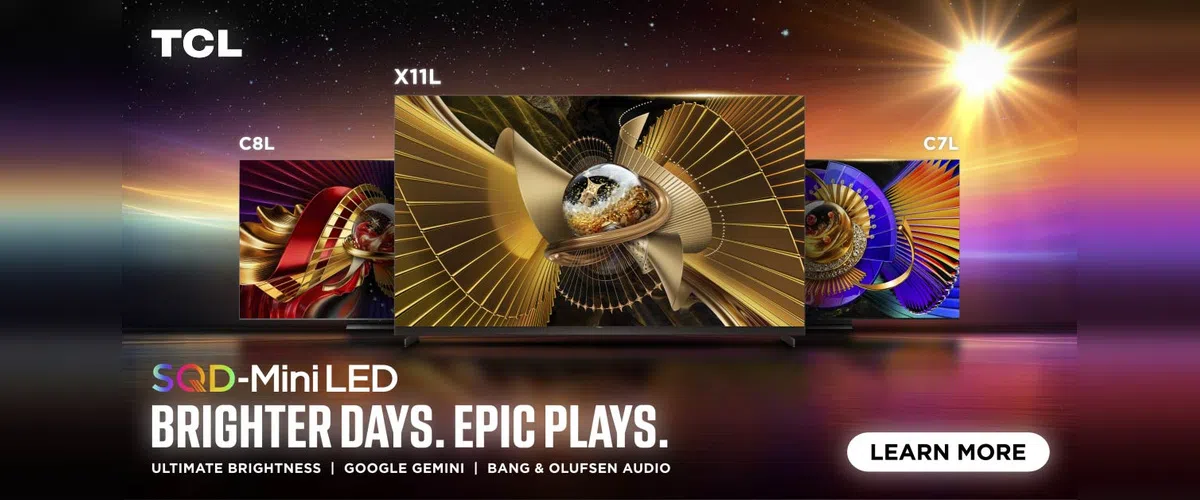
SQD Mini LED is TCL's flagship display technology for 2026 (Super Quantum Dots). It refines how light is filtered at the colour level to reduce "colour crosstalk" and maintain colour accuracy.
Unlike RGB Mini LED which changes the backlight itself, SQD Mini LED uses traditional blue LED backlight but combines newly formulated quantum dots with TCL CSOT's UltraColor Filter. This allows models like the X11L to achieve full coverage of BT.2020, DCI-P3, and Adobe RGB colour spaces.
TCL claims a 33% boost in colour gamut performance and a 69% improvement in quantum dot accuracy compared to previous generations.
Pros
- Exceptional brightness and colour: Flagship SQD models like the X11L can reach up to 10,000 nits peak brightness with over 20,000 dimming zones (on the 98" model)
- Cinema-grade colour: Engineered to achieve 100% BT.2020 with minimal crosstalk
- No burn-in: Like all Mini LED technologies
- Wide viewing angles: WHVA 2.0 Ultra Panel promises consistency
- Slimmer design potential: More compact than RGB setups
Cons
- Premium pricing: Flagship models command the highest price points (US pre-orders for X11L start at ~$7,000 for 75")
- Australian availability to be confirmed: Announced at CES 2026, but local pricing/launch not yet official
Head-to-Head: Key Differences at a Glance
Below is a comparison based on typical characteristics and verified specifications. Exact numbers vary by brand and model.
| Feature | SQD Mini LED | RGB Mini LED | QD Mini LED | OLED |
|---|---|---|---|---|
| Brightness | Exceptional; up to 10,000 nits on flagship X11L | Very high; 7,000-9,000+ nits (e.g. Hisense 116UX / TCL Q10M Ultra) | Very bright; up to 5,000 nits on TCL flagships | High but typically 1,000-1,500 nits |
| Colour Gamut | 100% BT.2020 coverage on X11L | 95-100% BT.2020 | Wide colour via Quantum Dots; typically ~97% DCI-P3 | Excellent accuracy; 85-90% BT.2020 typically |
| Contrast & Blacks | Excellent for LCD; over 20,000 dimming zones on X11L 98" | Very strong for LCD; thousands of RGB zones | Strong contrast with local dimming; thousands of zones | Pixel level control gives perfect blacks |
| Burn-In Risk | None in normal use | None in normal use | None in normal use | Low but non-zero with static content |
| Viewing Angles | Very good; WHVA 2.0 panel | Good; depends on panel type | Good; HVA panels improved | Excellent; retains quality from wide angles |
| Typical Price | Flagship premium (US$7,000+ for 75") | Ultra-premium (varies, often high for large sizes) | Strong value, especially at large sizes | Typically premium, especially at large sizes |
| Australian Availability | To be confirmed for 2026 | Limited; not widely available yet | Widely available across C6K/C7K/C8K ranges | Widely available from multiple brands |
Which One Fits Your Home?
Because each technology shines in different conditions, the "best" choice comes down to your room, habits, and priorities rather than a single winner.
Choose SQD Mini LED if…
- You want the absolute best picture quality TCL offers in 2026, with no compromises on brightness, colour, or contrast
- You are a home cinema enthusiast who watches a lot of HDR content and wants cinema-grade colour and extreme brightness
- You have a bright living space and want a picture that still pops during the day
- You're willing to wait for Australian availability confirmation and accept flagship pricing
Choose RGB Mini LED if…
- You want cutting-edge LCD tech with a strong focus on future-facing HDR colour and the widest colour gamut
- Your main viewing area is bright during the day, and you want extreme brightness (7,000+ nits)
- You're interested in early-adopter, ultra-premium products
Choose QD Mini LED if…
- You want a versatile, high-performance TV for a bright family living room that handles sports, streaming, and gaming equally well
- You like very high brightness (up to 5,000 nits), strong contrast, and vivid Quantum Dot colour at a more accessible price
- You're concerned about burn-in because you watch channels with logos or game with static HUDs
- You want proven, widely available technology with strong Australian retail support
Choose OLED if…
- You mostly watch in a dark or dimly lit room and care most about deep blacks and cinematic look
- You value ultra-slim design and are comfortable with basic care habits to minimise burn-in risk
- Modern protections give you confidence for mixed-use viewing
TCL's Role in the 2026 TV Landscape
TCL has been developing and shipping QD Mini LED TVs for several years, with thousands of local dimming zones and peak brightness levels verified at 4,500+ nits on flagship models. For 2026, TCL is pushing further with SQD Mini LED and RGB Mini LED technologies.
TCL's global TV lineup for 2026 includes:
- SQD Mini LED in the flagship X11L series — up to 10,000 nits, over 20,000 dimming zones (98"), 100% BT.2020, Dolby Vision, Google Gemini AI
- Next-gen RGB Mini LED models (e.g., Q10M Ultra) — up to 9,000 nits, 100% BT.2020 on large sizes
- Award-winning QD Mini LED ranges (C8K, C7K, C6K) — versatile bright all-rounders widely available in Australia
Currently available in Australia (2025/2026): The TCL C8K Premium QD Mini LED range is at major retailers like Harvey Norman, JB Hi-Fi. Up to 5,000 nits, thousands of zones, 144Hz gaming, strong value (e.g., 65" ~$1,655 to 98" ~$7,995 approx.).
Disclaimer: Australian availability, exact model names, specifications, and pricing for 2026 SQD Mini LED (X11L) and RGB Mini LED (Q9M, Q10M Ultra) models are subject to confirmation. Always refer to current TCL Australia product pages and local retailers for up-to-date details.
FAQs
1. What is the difference between SQD Mini LED and RGB Mini LED?
They take different approaches. RGB changes the backlight to separate red/green/blue LEDs. SQD refines Quantum Dot and filter layers for greater purity, reduced crosstalk, potentially more zones, and slimmer designs.
2. Is SQD Mini LED the same as MicroLED?
No. MicroLED is self-emissive like OLED but with inorganic LEDs. SQD is advanced LCD with Mini LED backlight and Super Quantum Dot layer.
3. Will these new technologies make my current QD Mini LED or OLED TV obsolete?
Not at all. Current premium models deliver excellent quality for years. New tech is a step forward in brightness/colour, especially for HDR and bright rooms.
4. Are these TVs good for gaming?
Yes — high refresh rates (120-144Hz+), HDMI 2.1, VRR. Mini LED options excel for long sessions with no burn-in risk.
5. Do I need special content for SQD or RGB Mini LED?
No — improvements visible on regular HDR. Full BT.2020 benefit grows as more content supports wider colour.
How to Use This Guide When You Shop
To get the most from this information:
- Start by deciding where the TV will live (bright lounge vs dark media room) and what you watch most (sports, movies, gaming, mixed family viewing)
- Use the technology overviews and comparison table here to shortlist one or two tech types that fit your room and habits
- Compare specific models—TCL and other brands—using independent reviews from outlets like RTings, What Hi-Fi, Tom's Guide, and Australian publications like CyberShack, as well as in-store demos and spec sheets, so you can weigh things like brightness, number of dimming zones, gaming features, and price at your preferred size
- Check current TCL Australia product pages for the latest availability, pricing, and specifications for Australian models
- Consider warranty coverage—TCL typically offers three-year warranties on their premium ranges in Australia
The future of TV really is brighter, more colourful, and more flexible than ever. Whether you land on SQD Mini LED, RGB Mini LED, QD Mini LED, or OLED, aligning the technology with your home and viewing style is the key to getting a screen you will love for years.

Tips

Tips

Sports & Streaming With TCL
2026-09-07
Tips

Tips


What Google TV Brings To TCL Smart TVs
2026-04-15
Tips


The Best Large Screen TCL TVs In 2026
2026-04-01
Tips

Tips


Tips

Tips

Tips

What Size TV Do You Really Need?
2026-02-25
Blog
New Tech

Best TCL TV For Bright Rooms
2026-02-25
Blog
New Tech

Gaming TV Buying Guide 2026
2026-02-25
Blog
New Tech

Tips

Tips

Blog
New Tech

Tips

Tips

Tips

The Ultimate Guide to Air Conditioner Modes
2025-02-26
Tips


Tips

Tips
Tips


Tips

New Tech


New Tech

New Tech

Tips
Tips

Air Conditioner Playbooks

Holiday Season
2023-12-17
Events

Be cool this summer
2023-12-17
New Tech

2023 Black Friday Sales
2023-11-16
Events


Events


The Evolution of TVs: What is a Smart TV?
2023-08-30
Tips


Tips

TCL 2023 TV Product Range Launch
2023-07-25
New Tech

TCL Celebrates New AFL Sponsorship From 2023
2023-07-18
Partnership

MiniLED vs OLED. A comparison
2023-07-11
New Tech

What is Quantam dot technology for Tv's
2023-07-04
New Tech

AFL powered by TCL Electronics
2023-04-13
Partnership


Boxing Day Sales 2022
2022-12-21
Tips

New Tech

Renegades Partner with TCL Electronics
2022-11-29
Events

TV: To Mount or Not to Mount?
2022-11-29
Tips

New Tech

New Tech

New Tech

Looking for a Big Screen TV?
2022-11-08
New Tech

New Tech

New Tech

The C9 Series – TCL's Best 4K TVs
2022-11-01
New Tech

Black Friday Sales Plus Cyber Monday 2022
2022-10-25
Events

Men's T20 Cricket World Cup 2022 Australia
2022-10-25
Events

TCL Sponsors Melbourne Cup 2022
2022-10-18
Events

Is it Time to Upgrade Your TV?
2022-10-04
New Tech

Best Streaming Apps 2022
2022-09-27
New Tech

TCL X9 Series TVs
2022-09-20
New Tech

Events

Men's AFL Grand Final 2022
2022-09-06
Events

IFA


New Tech


2022 TCL TV Range Launch
2022-08-03
New Tech

Google TV vs Android TV
2022-06-06
New Tech

What is Google TV?
2022-06-03
New Tech

MiniLED vs OLED
2022-05-23
New Tech

Watch Australian NRL on Your TCL Television
2022-05-21
Tips

Tips

How to Watch AFL on Your TCL TV
2022-05-14
Tips

TCL Ray Danz Soundbar Reviews
2022-05-10
New Tech

Fridge Buying Guide
2022-05-05
Tips

Tips

Freezer Buying Guide
2022-04-20
Tips

New Tech

Watching Soccer on Your TCL Television
2022-04-11
New Tech

Call of Duty: Vanguard
2022-01-05
New Tech

Soundbar Buying Guide
2021-12-29
Tips

Boxing Day 2021
2021-12-17
Events

The TCL C735 98" TV Overview
2021-12-15
New Tech

New Tech

What is the Ideal TCL TV for You?
2021-12-01
Tips

Smart TV and HD Televisions
2021-11-24
New Tech


TCL Black Friday and Cyber Monday 2021
2021-11-18
Events

TCL's Latest Australian Product Range
2021-11-17
New Tech

Is My TV a Smart TV?
2021-11-03
New Tech

How To Connect A DVD Player To A Television
2021-10-27
New Tech
New Tech

What Is a Mini-LED TV and Do You Need It?
2021-10-06
New Tech

Laser TV: Options, Specifications & Quality
2021-09-29
New Tech

Tips

New Tech

New Tech

New Tech

New Tech

How To Set Up Google Home on TCL TVs
2021-08-30
Tips

New Tech

New Tech

Top Mount Fridge: The Ultimate Buying Guide
2021-08-02
New Tech

Finding the Perfect Bar Fridge
2021-07-26
Tips

Best Budget Sound Bar For Your TV
2021-07-19
Tips

Choosing & Finding Sound Bars For Your TV
2021-07-12
Tips

New Tech

8K TV
2021-06-28
New Tech

Thinking of buying a 4K TV?
2021-06-21
New Tech

Why buy a 75 Inch TV?
2021-06-14
Tips

How to choose the best Smart TV for you
2021-05-31
Tips

Tips

Tips

TV Buying Guide: 6 Things You Need To Know
2021-05-17
Tips

Tips

New Tech

Android or Smart TV - What's the Difference?
2021-03-05
Tips

Top New TV Shows on Stan 2021
2021-02-26
Tips

Australian Sports We Love to Watch
2021-02-19
Tips

Tips

Top 10 Most Expensive TV Shows Ever Made
2021-02-05
Tips


New Tech

Boxing Day Sales in Australia
2020-12-11
Tips

Tips

How to Take Movie Night to the Next Level
2020-11-27
Tips

New Tech

Tips

Black Friday TV Deals
2020-11-06
Tips

Tips

Choosing the Right TCL Soundbar
2020-10-26
Tips

The New TCL X915 8K QLED Android TV
2020-09-15
New Tech

Mounting Your TV: What You Need To Know
2020-08-08
Tips

The New 2020 TCL P715 4K QUHD Android TV
2020-07-24
New Tech

Tips

New Tech

Tips


Tips

Tips

New Tech

How to Successfully Host an AFL Party
2020-03-12
Tips

Product Spotlight: Series X X7 QLED TV AI-IN
2020-02-03
Tips

Tips

Tips

How to Decorate a Room Around Your TV
2019-10-14
Tips

Tips

FIBA Basketball World Cup 2019
2019-08-26
Events

Tips

The Evolution of TV in Australia
2019-07-16
Tips

How to Buy a Premium TV on a Budget
2019-06-26
Tips

New Tech

2019 Q1 Shipment Release
2019-04-17
New Tech

8K TV and the Future
2019-04-01
New Tech

New Tech


New Tech


Events

Great Christmas Tech Gift Ideas From TCL
2018-11-19
Tips

Events

The Melbourne Spring Racing Carnival
2018-10-31
Events

The Perfect Sports and Gaming TV
2018-09-20
Tips

New Tech

Events

What is Chromecast & Why do I Need it?
2018-08-20
Tips

Buying a TV? Which TV Should You Buy?
2018-07-06
Tips


New Tech


Events

QLED vs OLED – What is the difference?
2018-04-10
Tips

Google Assistant & Artificial Intelligence
2018-03-23
New Tech

New Tech

Neymar Appointed TCL Ambassador
2018-02-13
Events

TCL Named CES 2018 Innovation Awards Honoree
2018-01-31
Events

Events

New Tech

Events

New Tech

Tips

Events


Events

TCL Android TV has arrived
2017-06-17
New Tech

5 Reasons Why You Need Netflix
2017-06-08
Tips

5 Reasons Why You Need Smart TV
2017-06-08
Tips

TCL Smart TV & FreeView
2017-06-08
New Tech
Which size TCL TV is best for you?
2017-06-08
Tips

Melbourne Victory partners with TCL
2017-01-17
News

News

Events

News



This site uses cookies to analyse site traffic, improve your experience and personalize ads or other contents. By clicking Accept or continuing to browse the site, you are agree to our use of cookies. See our Cookies Policy here. Learn more